
A norway fjords honeymoon is not a destination you arrive at. It is a landscape you move through — by train, by private boat, by coastal road — watching the light shift on water that reflects mountains so steep they seem to lean in over the two of you. Norway does not rush its guests. The fjords were carved by glaciers over millennia, and the country asks the two of you to travel at a pace that honours that geology: slowly, deliberately, with the windows down and the engine quiet.
This is not a cruise honeymoon. The massive ships that sail the fjords carry thousands of passengers through channels designed for silence, and the experience they offer is observation from a distance. A Norway fjords honeymoon designed properly is the opposite: ten nights moving between Bergen, the Flam Railway, Geirangerfjord, the Lofoten Islands and Tromso, staying in converted boathouses and fjordside lodges, eating what the kitchen caught that morning.
We design Norway honeymoons as slow journeys through light and water — combining the UNESCO fjords of the west with the Arctic archipelago of Lofoten in the north. The result is a honeymoon that covers three distinct Norways in ten nights, each one quieter and more dramatic than the last.
Why Norway Fjords for Your Honeymoon
The Silence of the Fjords
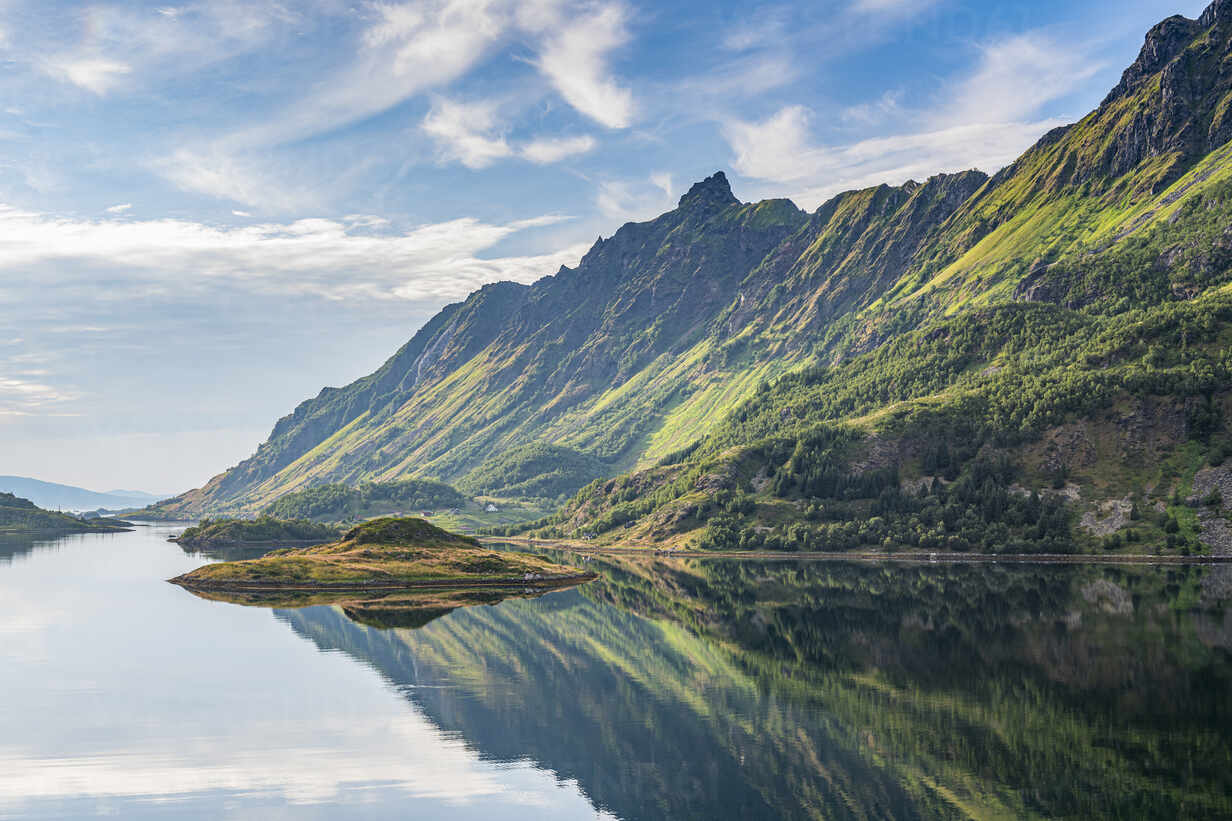
The fjords are not just scenery. They are a specific quality of silence that the two of you will not find anywhere else in Europe — the kind created by water enclosed between vertical rock walls, where sound has nowhere to travel and the only interruption is the occasional waterfall dropping from a ledge five hundred metres above. Naeroyfjord, the narrowest of Norway’s major fjords, is barely two hundred and fifty metres wide at its tightest point. Stand on the deck of a private boat in the centre of that channel and the mountains are close enough to feel their shade.
This silence is not emptiness. It is charged with detail: the rush of a waterfall heard from a kilometre away, the cry of a white-tailed eagle circling above the ridge, the low hum of the boat engine that the captain cuts when the two of you reach the inner fjord. Norway’s silence is not an absence of noise. It is the presence of everything else.
Midnight Sun or Northern Lights — Choosing Your Season
Norway offers two honeymoons depending on when the two of you arrive, and the choice shapes everything:
Summer (June to August): the midnight sun means the light never fully disappears. Above the Arctic Circle — in Lofoten and Tromso — the sun stays above the horizon for weeks. The fjords glow in a golden light that lasts from late evening through the early hours, and the two of you can hike, kayak, or sit on a terrace at midnight in full daylight. Roads are open. Coastal boats run. The temperature in the fjord regions hovers between twelve and eighteen degrees — cool enough for a jacket, warm enough for everything.
Winter (November to February): the northern lights replace the midnight sun. In Lofoten and Tromso the aurora dances above snow-covered peaks reflected in dark fjord water, and the experience of watching it from a private cabin — wood fire behind the two of you, green light above — is among the most intimate the north offers. Daylight is limited: three to four hours in the deep north, six to seven in Bergen. But the quality of that light — low, golden, fleeting — gives winter Norway a beauty that photographs cannot capture. For a deeper guide to planning around the aurora, see our northern lights honeymoon destinations.
For a honeymoon, we recommend summer for the full Ring Road-style journey through all three regions. Winter for couples who want Lofoten and Tromso focused on aurora and Arctic stillness.
Slow Travel, Not Cruise Tourism
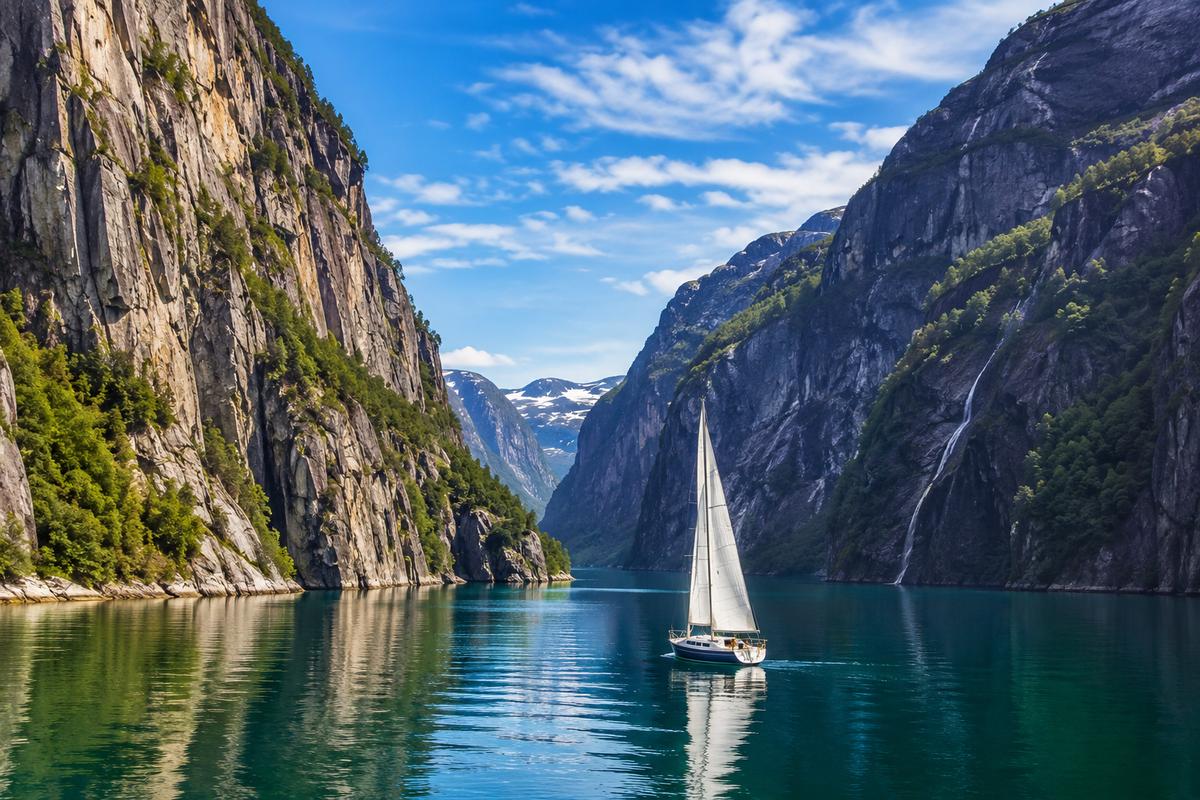
The massive cruise ships that enter Geirangerfjord each summer carry two to four thousand passengers into a channel that was designed by nature for perhaps a dozen. The wake alone erodes the shoreline. The experience is observation through glass, from height, at speed. A honeymoon in the Norwegian fjords should be the inverse: a private boat that holds four to eight people, a captain who knows which inlet to anchor in for lunch, and the freedom to cut the engine and drift in silence beneath the Seven Sisters waterfall.
Hurtigruten, the historic Norwegian coastal route, offers a middle path — a working postal ship that carries two hundred to five hundred passengers along the coast from Bergen to Kirkenes, stopping at thirty-four ports over eleven days. It is not private, but it is authentic: a working vessel, not a floating resort. For the two of you who want to combine fjords with the long Arctic coastline, Hurtigruten adds context that no private itinerary can replicate.
The Journey: 10 Nights Through the Fjords
Ten nights covers three distinct regions at a pace that allows the landscape to settle. Seven nights is possible by cutting Tromso, but the north is where Norway becomes extraordinary — and where the two of you will wish the honeymoon were longer.
Nights 1-2: Bergen — Gateway to the Fjords
Bergen is where Norway begins. The wooden houses of Bryggen — the Hanseatic wharf, a UNESCO World Heritage site — line the harbour in colours that have weathered four centuries of North Sea rain. Walk the fish market. Take the Floibanen funicular to the viewpoint above the city. Eat at Lysverket, the restaurant inside the KODE art museum that serves modern Norwegian cuisine with the harbour visible through the windows. Eilert Smith Hotel, a converted nineteenth-century building on the waterfront, is the kind of property that sets the tone for the journey: design-led, locally rooted, and quiet enough that the two of you hear the harbour through the open window.
Hardangerfjord, Norway’s second-longest fjord, is a ninety-minute drive from Bergen and makes a strong day trip — orchards along the waterline in summer, the Voringsfossen waterfall dropping into a narrow canyon, and a landscape gentler than the dramatic western fjords ahead.
Night 3: The Flam Railway and Naeroyfjord
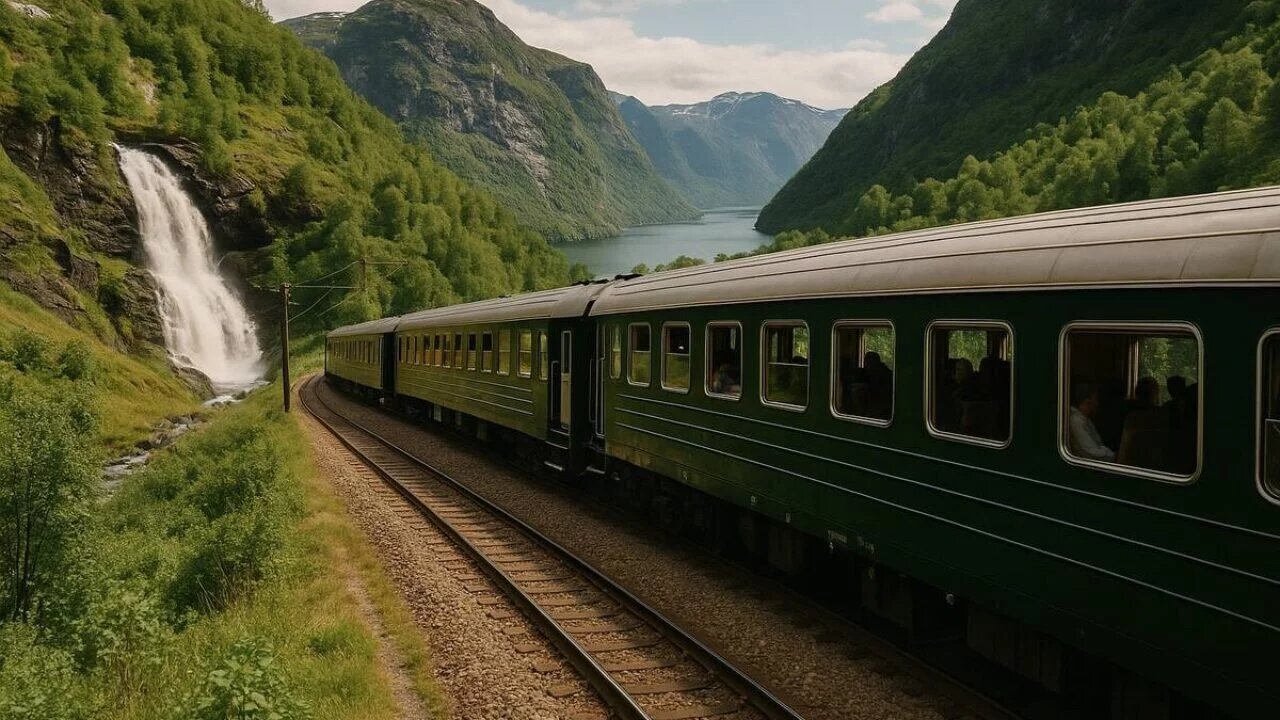
The Flam Railway is not transport. It is one of the most dramatic rail journeys in the world — a twenty-kilometre descent from the mountain station at Myrdal to the village of Flam at sea level, dropping eight hundred and sixty-three metres through tunnels carved into the rock face, past waterfalls that the train pauses beside, and through a landscape that shifts from alpine snow to fjord-level green in fifty minutes. The two of you will press against the window for the entire descent.
From Flam, a boat takes the two of you into Naeroyfjord — a UNESCO World Heritage fjord so narrow that the mountains seem to close above. Sognefjord, of which Naeroyfjord is a branch, is Norway’s longest and deepest — two hundred and four kilometres from the coast to the innermost village. The scale is difficult to grasp until the two of you are inside it, looking up at rock walls that rise more than a thousand metres from water that is itself over a thousand metres deep.
Nights 4-5: Geirangerfjord by Private Boat
Geirangerfjord is Norway’s most famous fjord, and it earns the reputation. The Seven Sisters waterfall — seven separate streams that cascade down the cliff face on one side of the fjord — faces the Suitor, a single waterfall on the opposite cliff, and the local legend that explains the arrangement is told by every boat captain in the region. The fjord is fifteen kilometres long, flanked by abandoned farms on ledges that seem impossibly steep, and at its inner end the village of Geiranger sits in a bowl of green beneath mountains that receive more rainfall than anywhere else in Norway.
Storfjord Hotel, twenty minutes from Geiranger by road, is the accommodation that defines this section of the honeymoon. A converted farmstead on the shore of Storfjorden — the larger fjord that feeds into Geiranger — with twelve rooms, a wood-fired sauna at the waterline, and a kitchen that serves what grows within walking distance. The hotel is what Norway does better than almost any country: luxury defined by restraint, not excess. Two nights here gives the fjord time to reveal its moods — mist in the morning, clarity at noon, golden light that lasts past ten in the evening.
Nights 6-7: The Lofoten Islands
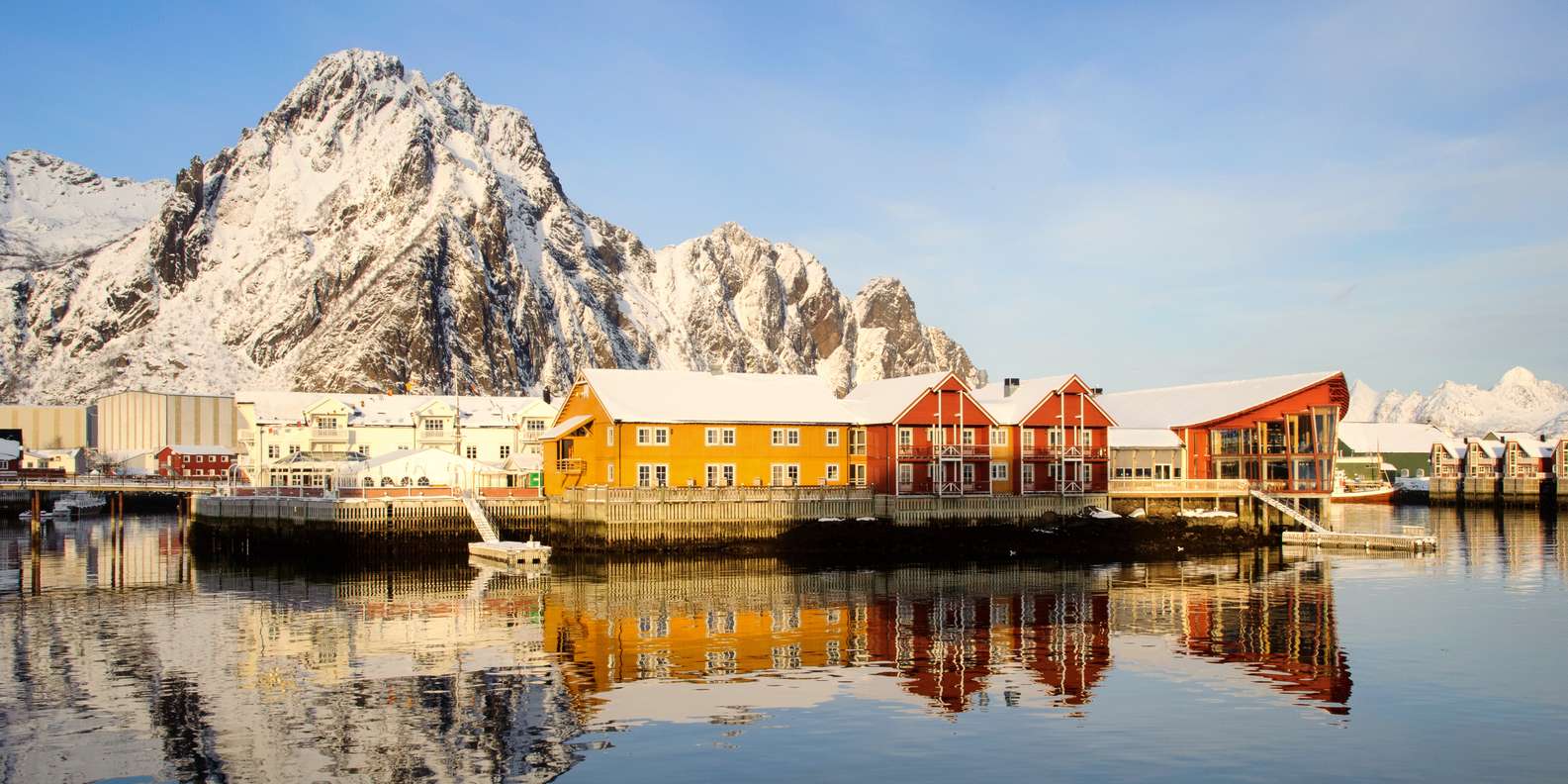
The Lofoten Islands are where Norway shifts register entirely. An archipelago above the Arctic Circle — connected by bridges and tunnels — where jagged granite peaks rise directly from the sea and the villages are clusters of red rorbuer, the traditional fishermen’s cabins built on stilts over the water. Lofoten in summer is the midnight sun at its most surreal: the two of you can kayak at midnight beneath peaks that glow pink and gold, or hike to Reinebringen for a view that has no equivalent in mainland Europe.
Stay in a converted rorbu in Reine or Svolvær. The cabins have been restored with modern interiors — heated floors, full kitchens, waterfront decks — but the structure is unchanged: timber over water, the sound of the harbour at night, and a view of mountains that makes every morning feel like a first. The fishing culture is alive here. Eat stockfish at a harbourside restaurant, watch the boats come in at dawn, and understand that Lofoten is not a resort destination. It is a working landscape that happens to be one of the most beautiful places on earth.
Nights 8-10: Tromso and the Northern Edge
Tromso, the largest city above the Arctic Circle, anchors the final section of the honeymoon. In summer, the midnight sun turns the harbour into a scene that feels artificial in its beauty — boats, mountains, and light that refuses to set. In winter, Tromso is the most reliable base for northern lights in Norway, with aurora-watching excursions that take the two of you by boat to the outer islands where light pollution disappears entirely.
The Arctic Cathedral — a modernist landmark in concrete and glass — catches the northern light in a way that makes it worth visiting twice, once at midday and once near midnight. Whale watching runs from November through January, when orca and humpback whales follow the herring into the fjords around Tromso. And from Tromso, the two of you can take a day trip to Sommaroy, a cluster of white-sand beaches on an Arctic island that looks like it belongs in the Caribbean — except that the water temperature reminds the two of you exactly where you are.
Best Time to Visit Norway
June to August for the midnight sun, open mountain roads, the Flam Railway at its most dramatic, and kayaking in Lofoten. This is the window we recommend for the full ten-night journey. Late June to mid-July is peak: the longest light, the warmest water, and the greenest valleys. September adds autumn colours and the first aurora sightings in the north, with fewer visitors and lower rates. November to February for the northern lights, whale watching in Tromso, and the experience of snow-covered fjords in near-darkness — a more focused journey through Lofoten and the Arctic north. For broader context on planning a polar honeymoon, see our Iceland honeymoon or Greenland honeymoon guides.
How We Plan a Norway Fjords Honeymoon
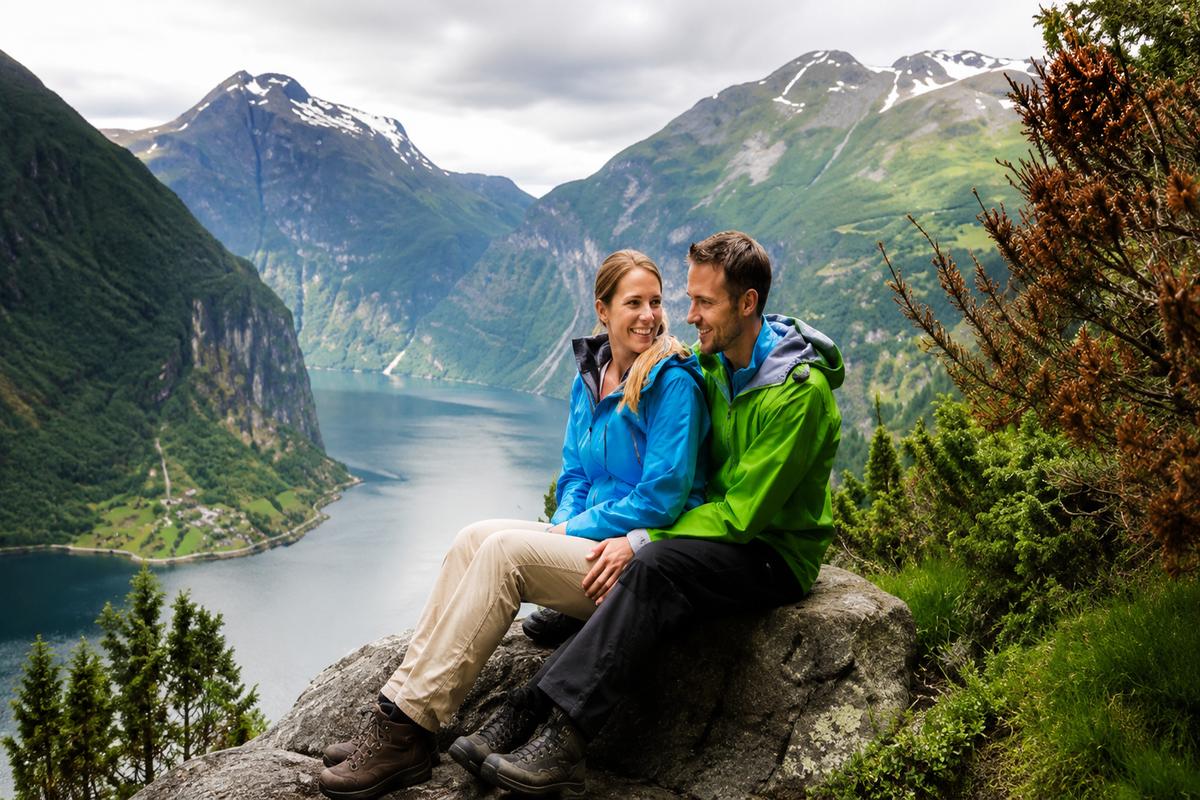
Norway’s logistics are straightforward — domestic flights connect Bergen, the fjord region, and Tromso — but the choices within that simplicity define the honeymoon. Which fjord deserves two nights? Where to anchor for lunch in a private boat? Whether to take the Flam Railway or drive the mountain road? Whether to add Lofoten or extend the fjord region? We begin with a conversation about what the two of you want: whether the journey is about fjords, Arctic light, or both.
We arrange the domestic flights, select the lodges and boutique hotels, and build a day-by-day route that balances driving with boat excursions. Our Norway partners handle the details — the private fjord boats, the Flam Railway bookings, the restaurant reservations at places the two of you would never find without a local connection.
Frequently Asked Questions
Which Norwegian fjord is best for a honeymoon?
Geirangerfjord for dramatic waterfalls and classic fjord scenery. Naeroyfjord for intimacy — a UNESCO-listed fjord so narrow the mountains nearly touch above. Sognefjord for depth and scale. Each offers a different character, and the best honeymoon combines at least two.
Is Lofoten good for couples?
Exceptionally. The Lofoten Islands combine dramatic Arctic scenery with intimate rorbuer cabins, midnight sun in summer, and northern lights in winter. The fishing culture, the hiking, and the sheer beauty of the archipelago make Lofoten the most rewarding extension to a Norway fjords honeymoon.
Best time to visit Norway fjords?
Late June to mid-July for the longest midnight sun, warmest temperatures and open roads. November to February for northern lights and Arctic atmosphere. September for autumn colours and fewer visitors.
How many days for Norway fjords?
Seven nights covers Bergen, the Flam Railway and Geirangerfjord comfortably. Ten nights adds the Lofoten Islands and Tromso — the extension that transforms a strong honeymoon into an exceptional one.
Geirangerfjord vs Sognefjord — which should we visit?
Visit both. Sognefjord is Norway’s longest and deepest, with Naeroyfjord as its most dramatic branch. Geirangerfjord is the most photogenic, with the Seven Sisters waterfall and abandoned cliff farms. They are two hours apart and complement each other perfectly on a honeymoon itinerary.
Norway does not compete for attention. It does not need to. The fjords, the light, and the silence do the work — and the two of you arrive, slow down, and discover that the pace the country offers is the pace the honeymoon needed all along. For the two of you who want a honeymoon measured in light rather than landmarks, this is where we would begin.
Begin Your Norway Fjords Honeymoon
Tell us whether you want midnight sun or northern lights, fjords or Arctic islands. We’ll design the journey from Bergen to the north.