
A bolivia honeymoon begins at altitude — three thousand six hundred metres above sea level, where the air is thin, the light is sharp, and the landscape operates on a scale that the two of you have never encountered. Bolivia is the Salar de Uyuni — the largest salt flat on earth, ten thousand square kilometres of white that extends to the horizon in every direction. It is La Paz, the world’s highest capital, built into a canyon so steep the buildings seem to climb the walls. It is Lake Titicaca, the highest navigable lake on the planet, where the Bolivian shore holds ruins and islands that the tourist crowds on the Peruvian side never see.
This is not an easy honeymoon. The altitude is real — the two of you will feel it in the first hours, in the shortness of breath on a staircase, in the headache that coca tea eases but does not eliminate. Bolivia asks something of the traveller before it gives. What it gives is a landscape so surreal that the photographs look manipulated, a culture rooted in the Andes that predates the Inca, and a honeymoon that the two of you will describe for years and still not quite convey.
We design Bolivia honeymoons as seven to ten-night journeys across three regions: the salt flats, the capital, and the lake. The result is a honeymoon that operates at the edge of altitude — visually, physically, and emotionally.
Why Bolivia for Your Honeymoon
Salar de Uyuni — The Mirror at the Top of the World
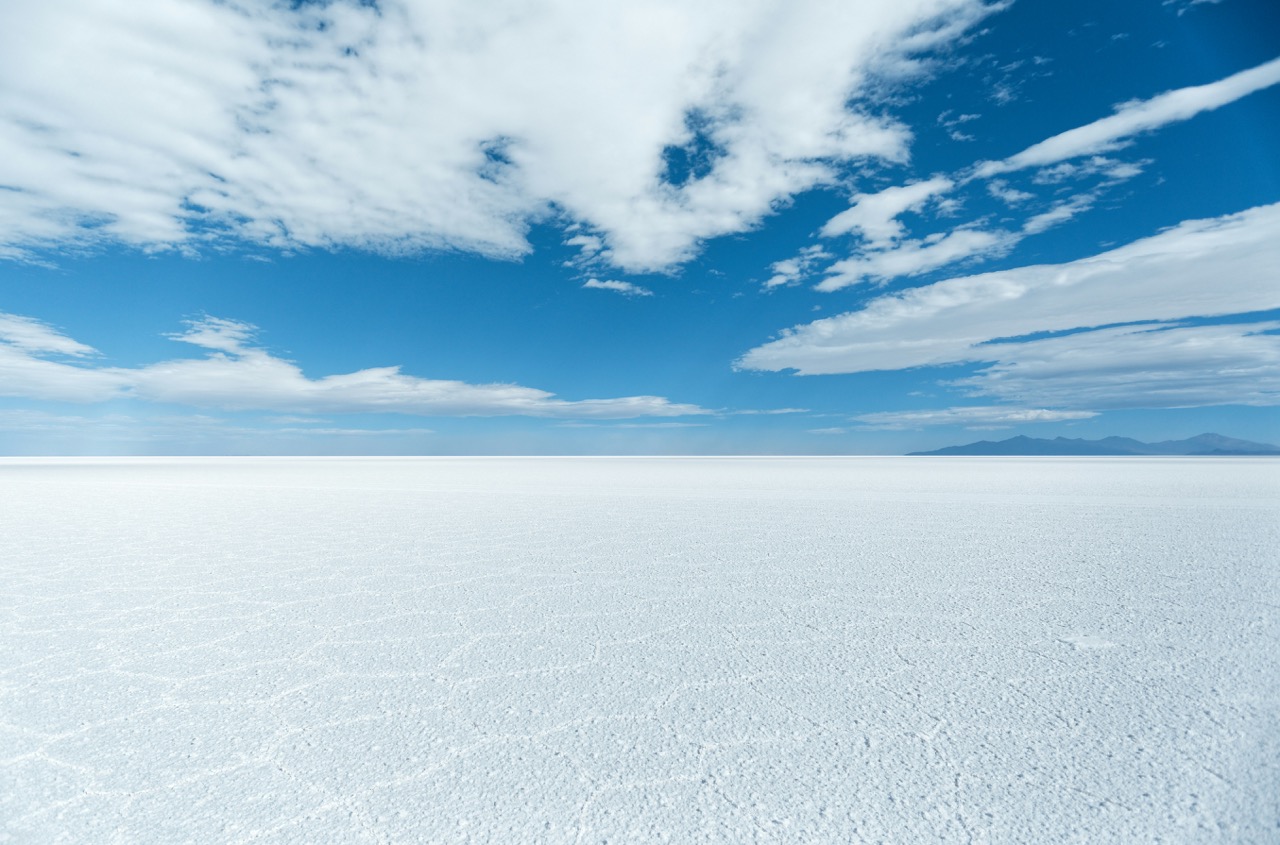
The Salar de Uyuni is the image that sells Bolivia and the experience that justifies the altitude. In the dry season (May to October), the salt flat is a blinding white expanse — the hexagonal patterns of crystallised salt stretching in every direction, interrupted only by the occasional island of cacti rising from the surface. In the wet season (December to March), a thin layer of water covers the salt, transforming the entire flat into a mirror that reflects the sky so perfectly that the horizon disappears and the two of you stand in what appears to be an infinite blue void. The mirror effect is the most photographed phenomenon in South America, and the two of you will take a hundred photographs and keep perhaps five — because no camera fully captures the disorientation of standing in a landscape with no edge.
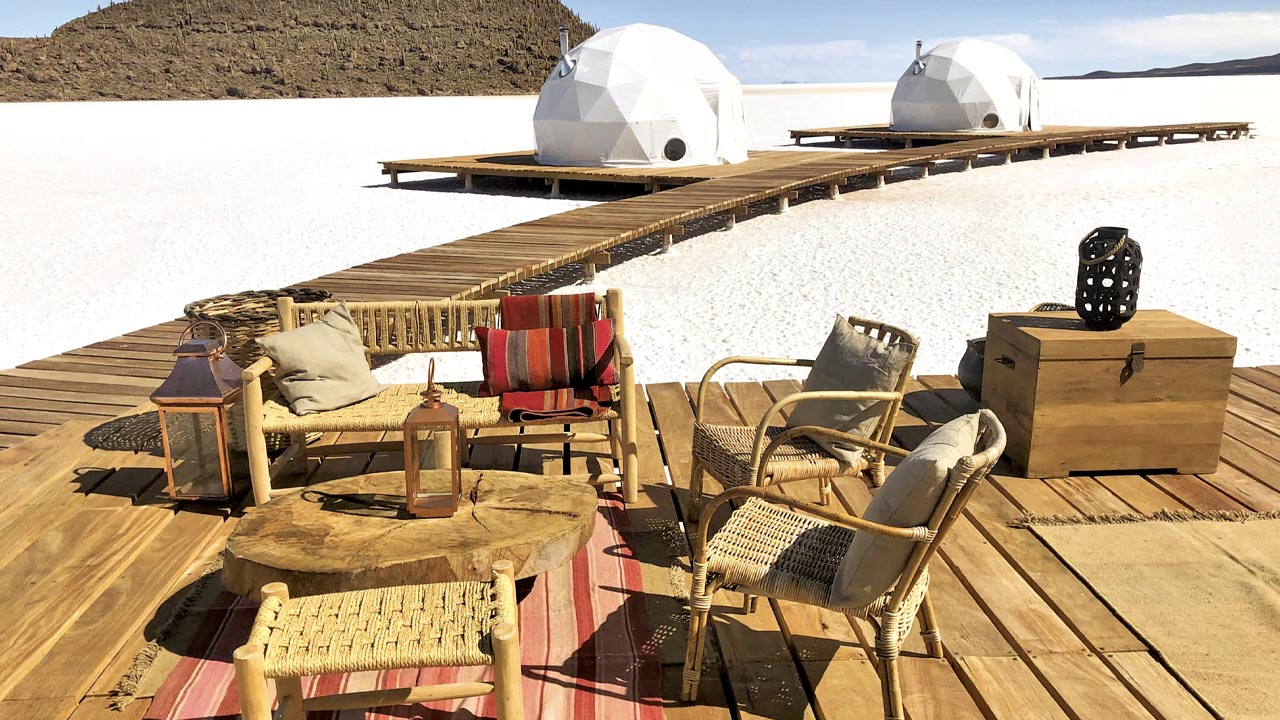
Kachi Lodge, the only accommodation on the salt flat itself, is a collection of geodesic domes on the edge of the Salar with views of the Tunupa volcano and the salt stretching to the horizon. The lodge is solar-powered, heated against the cold desert nights, and positioned so that the two of you watch the sunset turn the salt pink from the terrace. Hotel de Sal Luna Salada, built entirely from salt blocks on the Salar’s edge near Colchani, is the alternative: walls, floors, and furniture carved from the salt beneath the building.
La Paz — A City in a Canyon
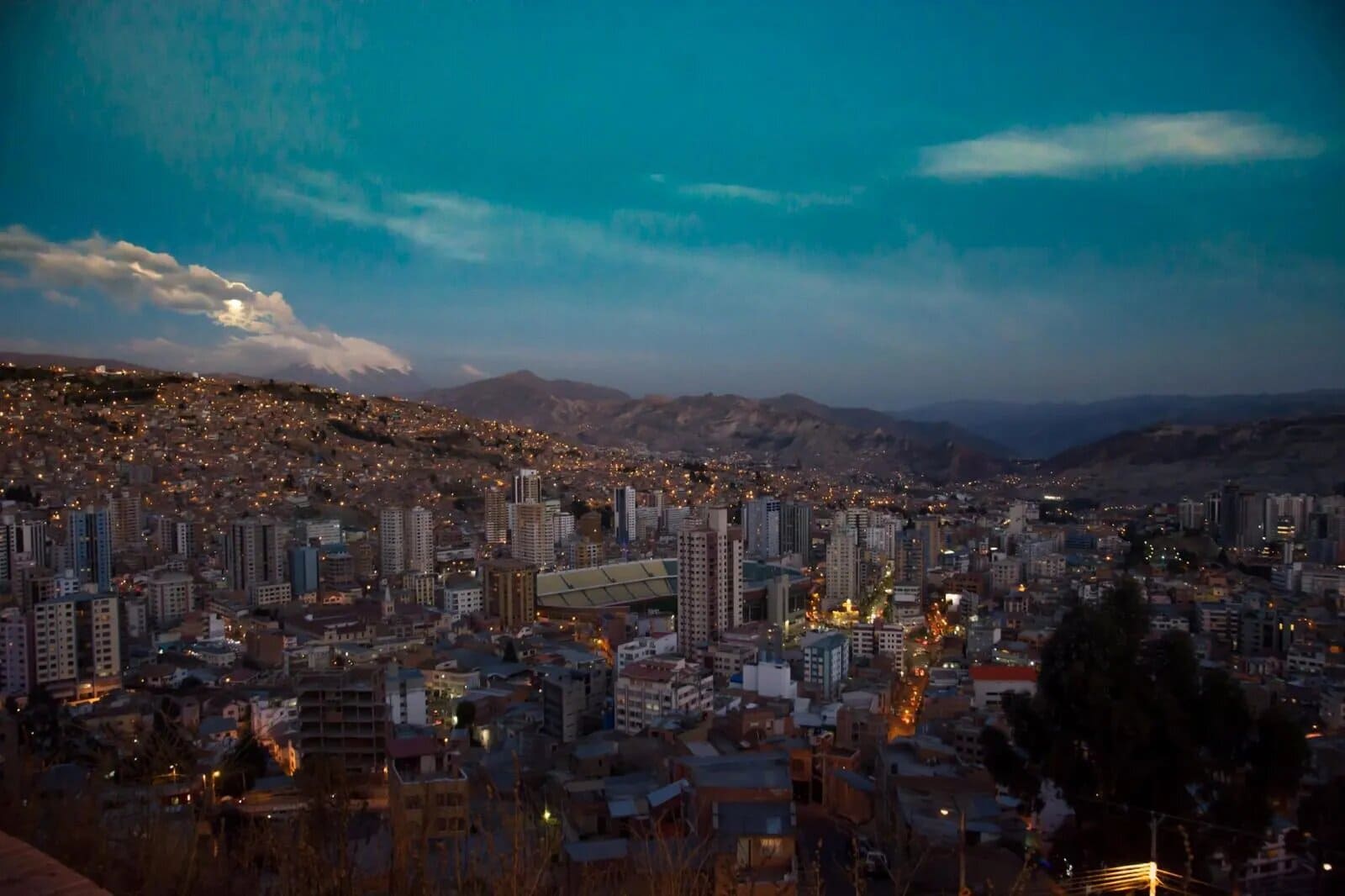
La Paz sits in a bowl surrounded by mountains, with the snow-capped peak of Illimani rising six thousand four hundred metres behind the city. The teleférico — a network of cable cars that connect the city’s neighbourhoods — gives the two of you aerial views of the canyon geography: the colonial centre below, the Aymara markets of El Alto above, and the entire city layered between three and four thousand metres of altitude. The Witches’ Market in the old town sells llama foetuses, dried herbs, and amulets that are part of Aymara spiritual practice — not a tourist curiosity but a functioning market where the two of you are the observers, not the audience.
Atix Hotel, in the Zona Sur district, is the design-led option: a glass and concrete property with views of the canyon and a restaurant serving contemporary Bolivian cuisine that draws on Andean ingredients — quinoa, chuño, llama, and the native potatoes that come in varieties the two of you did not know existed.
Lake Titicaca — The Bolivian Shore
Lake Titicaca, at three thousand eight hundred metres, is the highest navigable lake in the world — shared between Bolivia and Peru. The Peruvian side gets the tour groups. The Bolivian side gets the quiet. Isla del Sol, the largest island on the Bolivian side, holds Inca ruins and Aymara villages connected by stone paths that have been walked for centuries. The Tiwanaku archaeological site, an hour from La Paz, predates the Inca by a millennium — the Gate of the Sun, the Akapana pyramid, and the carved monoliths that represent a civilisation the two of you have likely never heard of.
The Journey: 7-10 Nights Across Bolivia
Seven nights covers the three anchors — Uyuni, La Paz, Titicaca — at a pace that respects the altitude. Ten nights adds Sucre, Bolivia’s constitutional capital and its most beautiful colonial city, and deeper exploration of the Salar’s surrounding landscapes.
Nights 1-3: Salar de Uyuni and the Altiplano

Fly from La Paz to Uyuni and drive to Kachi Lodge or Luna Salada. Day one: the salt flat itself — a full-day excursion across the Salar, stopping at Incahuasi Island, a rocky outcrop covered in giant cacti that is the only vertical element in an otherwise flat world. The perspective photographs — where the flat surface and the absence of reference points allow the two of you to create impossible compositions — are the signature of Uyuni, and the guide knows every trick. Day two: the coloured lagoons of the Eduardo Avaroa Reserve to the south — Laguna Colorada, red with algae and populated by flamingos at four thousand metres; Laguna Verde, turquoise at the foot of the Licancabur volcano. Day three: sunrise on the Salar, when the salt crystals catch the first light and the flat glows gold before the white returns.
Nights 4-6: La Paz and Tiwanaku
Fly back to La Paz. Three nights gives the two of you time to adjust to the altitude (La Paz is lower than Uyuni, which helps), explore the city at walking pace, and take the day trip to Tiwanaku — the UNESCO World Heritage site that was the capital of an empire covering modern Bolivia, Peru, and Chile from around 500 to 1000 AD. The Akapana pyramid, the Kalasasaya temple, and the Gate of the Sun are carved from stone transported from quarries over a hundred kilometres away — logistics that the Tiwanaku achieved without the wheel, without iron tools, and without written language.
In La Paz itself: the San Francisco Basilica and its terrace view of the city. The National Museum of Ethnography and Folklore, which holds textiles and artefacts from Bolivia’s indigenous cultures. And the evening walk along the Prado, the tree-lined boulevard that runs through the colonial centre, where the two of you eat salteñas — the Bolivian empanada, spiced and filled with a broth that requires a technique to eat without spilling.
Nights 7-8: Lake Titicaca and Isla del Sol
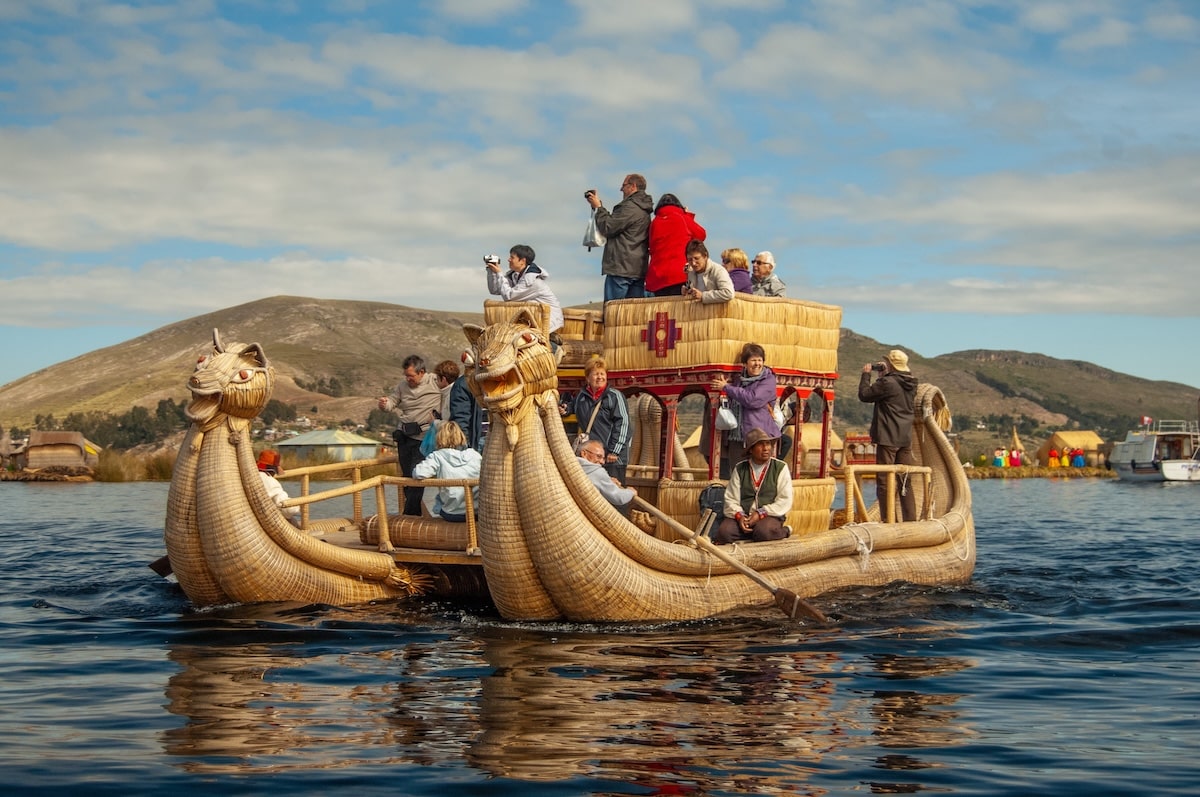
Drive from La Paz to Copacabana, the Bolivian lake town, and take the boat to Isla del Sol. The island has no cars, no roads, and no noise beyond the wind and the lake. Walk the Inca steps from the southern landing to the northern ruins — a ridge walk that takes three to four hours and passes through villages where the Aymara families tend terraced fields that have been cultivated since before the Spanish arrived. The ruins at the northern end — the Chinkana labyrinth, the Sacred Rock — look out over the lake toward the Peruvian shore and the Cordillera Real mountains behind.
One night on Isla del Sol is sufficient to feel the altitude, the quiet, and the view. Return to Copacabana and drive back to La Paz for the departure flight.
Nights 9-10: Sucre — The White City (Extension)
Sucre, two hours by air from La Paz, is Bolivia’s most elegant city — white colonial architecture, a temperate altitude of twenty-eight hundred metres (noticeably easier to breathe), and a cultural scene that includes the MUSEF textile museum, the Recoleta viewpoint, and the dinosaur footprints of Cal Orck’o, a limestone quarry on the city’s edge where five thousand tracks from the Cretaceous period are preserved on a vertical wall. Two nights in Sucre is the extension that gives the honeymoon a gentler closing chapter — lower altitude, warmer air, and a colonial beauty that contrasts with the raw Altiplano above.
Best Time to Visit Bolivia
May to October is the dry season — the best weather for the Salar (solid salt, clear skies, cold nights) and for trekking. December to March is the wet season — the Salar mirror effect is at its peak, but roads can flood and the Altiplano is cloudier. We most often recommend late May to June for a Bolivia honeymoon: dry conditions, manageable cold, and the fewest visitors. For the mirror effect specifically, January to February is the window — but the logistics are more complex and the two of you should expect some disruption.
How We Plan a Bolivia Honeymoon
Bolivia’s logistics are the most demanding in South America — domestic flights are irregular, roads are unpaved on the Altiplano, and altitude acclimatisation must be built into the schedule. We begin with a conversation about fitness, altitude experience, and whether the two of you want the dry-season salt flat or the wet-season mirror. From there, we build a route with internal flights, private transfers, and lodge bookings arranged through our Bolivia partners.
We recommend arriving in La Paz a day before the itinerary begins to acclimatise — coca tea, slow walking, and an early night. The altitude is not dangerous for healthy adults, but it is real, and the honeymoon works better when the two of you give the first day to adjustment rather than exploration. For the two of you interested in broader off-the-beaten-path destinations, see our off-the-beaten-path honeymoon destinations guide.
Frequently Asked Questions
Can you honeymoon in Bolivia?
Yes — for the two of you who want a visually surreal, culturally deep honeymoon at altitude. The Salar de Uyuni alone justifies the journey. Combined with La Paz and Lake Titicaca, Bolivia offers a honeymoon unlike any other destination in South America.
How many days do you need in Bolivia for a honeymoon?
Seven nights covers the Salar de Uyuni, La Paz and Lake Titicaca. Ten nights adds Sucre for a gentler closing chapter at lower altitude.
Is altitude a problem in Bolivia?
The altitude is real — La Paz sits at three thousand six hundred metres, Uyuni at thirty-seven hundred. Most healthy adults adjust within one to two days with coca tea, hydration, and a slow pace. We build acclimatisation time into every itinerary.
When is the best time to visit the Salar de Uyuni?
May to October for the dry salt flat with clear skies and solid surface. January to February for the mirror effect, when a thin layer of rainwater transforms the flat into a perfect sky reflection. Each season offers a different Salar.
Is Bolivia safe for a honeymoon?
Yes, with appropriate planning. Bolivia’s tourist corridors — La Paz, Uyuni, Sucre, Titicaca — are well-travelled and safe with a local guide and private transport. Petty theft in La Paz markets requires the usual urban awareness, but the Altiplano and the Salar are among the safest environments in South America.
Bolivia is not the honeymoon of least resistance. The altitude challenges, the distances stretch, and the landscape refuses to conform to anything the two of you have seen before. That refusal is the point. For the two of you who want a honeymoon that operates at the edge of the familiar — visually, physically, and culturally — this is where we would begin.
Begin Your Bolivia Honeymoon
Tell us whether you want the dry salt flat or the wet-season mirror, and how many nights you have. We’ll design the journey from La Paz to the Salar and back.